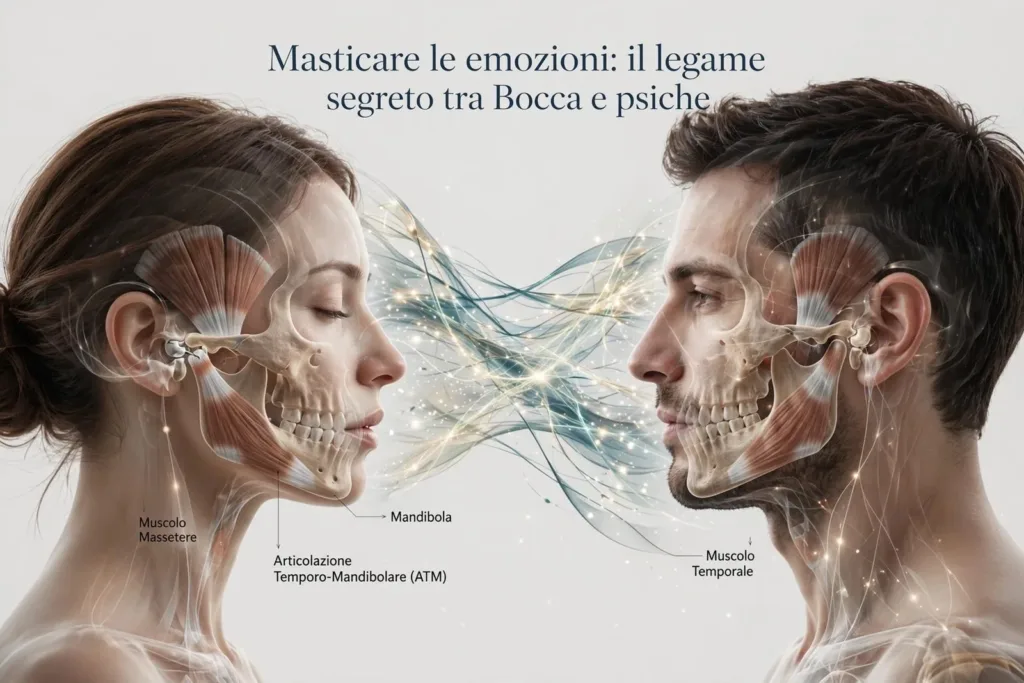
When we think about our eating habits, we rarely connect the way in which we chew — or do not chew — to what we feel emotionally. And yet, according to psychophysiology, body and mind communicate through a far more concrete channel than we imagine: the muscles.
From psychoanalysis to the body
Freud had intuited that the earliest experiences linked to the mouth — sucking, tasting, biting — lay the foundations of the adult personality. Psychophysiology, in particular the studies conducted from the 1980s onwards by the researcher Vezio Ruggieri, has tried to translate this intuition into measurable terms: no longer only unconscious symbols and meanings, but real muscle tension, recordable with an electrode.
The underlying idea is that instinctive behaviours — including eating — work as a two-phase cycle: a phase of accumulation of excitation (hunger, desire) and a phase of discharge which, in the case of the mouth, corresponds precisely to chewing.
Four ways of experiencing food
Research describes several “oro-alimentary styles”:
• The suction type: eats greedily, struggles to chew and to stop — a pattern that can favour overweight or binge eating.
• Those who compensate with partial chewing behaviours: chew gum, bite their lips, smoke.
• The type with “artificial stops”: represses emotions by clenching the teeth, often with nausea or heartburn.
• The smoker: a pattern of its own, less connected to the others.
An interesting finding: those with a low level of muscle tension around the mouth tend to have more difficulty “stopping” while eating. Muscle tension, in short, also works as a natural brake.
Chewing to process, not only to nourish oneself
One of the most fascinating aspects concerns young children who refuse to chew, continuing to prefer blended foods beyond the expected age. Observations carried out in school settings suggest that these children often also struggle with other symbolically “destructive” activities, such as knocking down building blocks or tearing paper. Through targeted play — working with clay, acting out the biting of animals — it is possible to help them gradually unblock this difficulty, often with rapid results.
A brake that is also a door
Chewing does not serve only to digest: it seems to work as a genuine “stop signal” towards the brain centres of hunger and, at the same time, as an outlet for aggressive tensions that find no other release. Not by chance, those who manage to chew — or to “destroy” symbolically through play — often show fewer traits of repressed hostility.
What we take home
This line of research reminds us that our habits at the table are not only a matter of willpower or diet: they also say something deeper about how we handle pleasure, frustration and even anger. Observing how we eat — calmly or anxiously, chewing or “swallowing” everything — can be a small mirror of how we face life.
Article inspired by the study by Sara Della Giovampaola, “The role of muscles in instinctive oro-alimentary behaviour”, Il Politecnico, no. 1-2, 2018, based on the research of Vezio Ruggieri.
Dr. Massimiliano Costantino
This site uses technical cookies required for it to work and, only with your consent, third-party content (Google Maps). Read the Privacy Policy and the Cookie Policy.