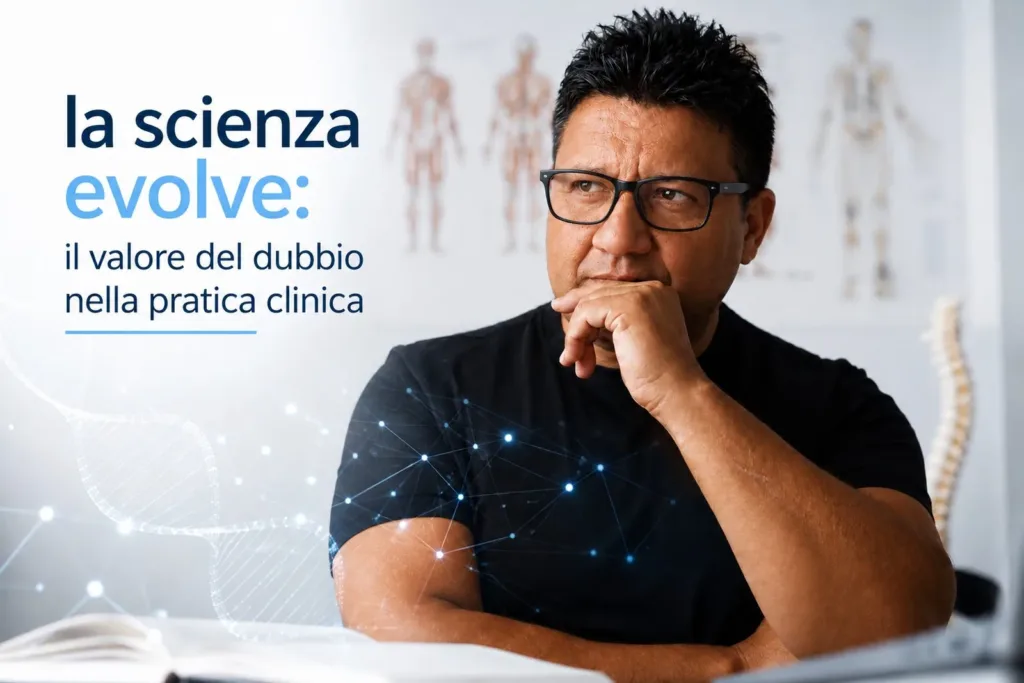
Prof. Mark Langlade, paraphrasing the philosopher Karl Popper, describes three attitudes that characterize the way of doing science:
those who contribute to change, continually questioning their own knowledge and seeking new solutions;
those who observe change, progressively adapting to the new evidence;
those who do not realize that change has already occurred, continuing to rely exclusively on the certainties of the past.
This last category includes those professionals who, although driven by the best intentions, prefer to take refuge in the convictions handed down by authoritative predecessors rather than confront new knowledge and scientific evidence.
Every professional choice deserves respect, but it is important to remember that medicine – and with it all the health disciplines – is not an exact science. Knowledge evolves continuously: what we consider established today may tomorrow be revised, corrected or even superseded by new evidence. As Prof. Giuseppe Stefanelli recalled, in clinical practice certainties must always confront the progress of research.
For this reason I believe that in science one may fall in love with a theory, but must never marry it definitively. Every theory is a tool for understanding reality, not an absolute truth.
The origin of every clinical reasoning arises from a fundamental question that has revolutionized modern scientific thought since the time of Galileo Galilei:
What does this phenomenon derive from?
It is this question that guides the diagnostic process and makes it possible to build rigorous clinical reasoning.
To answer correctly it is necessary to integrate three fundamental elements:
an accurate collection of the medical history;
a complete and thorough clinical examination;
the ability to interpret the collected data critically.
But above all one must never forget the true meaning of medicine: the art of caring for the person, not simply the disease.
For this reason every professional should ask himself a question as simple as it is essential:
Are we treating the images contained in the medical record… or are we treating the patient in front of us?
Instrumental investigations are a valuable support, but they can never replace the listening, the clinical observation and the reasoning of the professional. The diagnosis arises from the integration of scientific evidence, clinical experience and individual evaluation of the person.
Only by adopting this approach is it possible to offer a truly personalized medicine, founded on the best available evidence but always centered on the patient.
Dott. Massimiliano Costantino
This site uses technical cookies required for it to work and, only with your consent, third-party content (Google Maps). Read the Privacy Policy and the Cookie Policy.