In recent years attention has grown toward the relationship between the stomatognathic system, posture and balance. This system, which includes the teeth, mandible, tongue, masticatory muscles and related structures, plays a fundamental role in numerous essential functions of daily life.
The control of the stomatognathic system involves six pairs of cranial nerves and a very large portion of the sensorimotor cortex (Fig. 1). This fact highlights the neurological complexity of a system responsible for indispensable functions such as sucking, salivation, swallowing, chewing, phonation and oral breathing.
If we compare this system with other body regions, such as the lower limbs, it becomes evident how the stomatognathic system is subjected daily to continuous and highly specialized activity. Precisely for this reason it is frequently involved in functional alterations that can affect the person’s general well-being.
In recent years I have devoted much of my clinical work and of my study to palpatory anatomy and to the biomechanics of two fundamental aspects: dental occlusion and swallowing.
Dental occlusion means the way in which the upper and lower teeth come into contact when the mouth closes. During swallowing, maximum dental intercuspation is normally reached.
Swallowing is a complex process that allows the food bolus to pass from the oral cavity to the digestive tract. It begins as a voluntary act and continues automatically through reflex mechanisms.
It is a continuous, rhythmic and physiological function that is repeated on average between 1,500 and 2,000 times a day. It begins already during fetal life and continues even during sleep, a testament to its biological importance.
In my clinical experience I have frequently observed, in patients suffering from headache, cervical pain and difficulty swallowing, alterations of the physiological cervical curve, such as straightening or, in some cases, inversion of the cervical lordosis (Fig. 3).
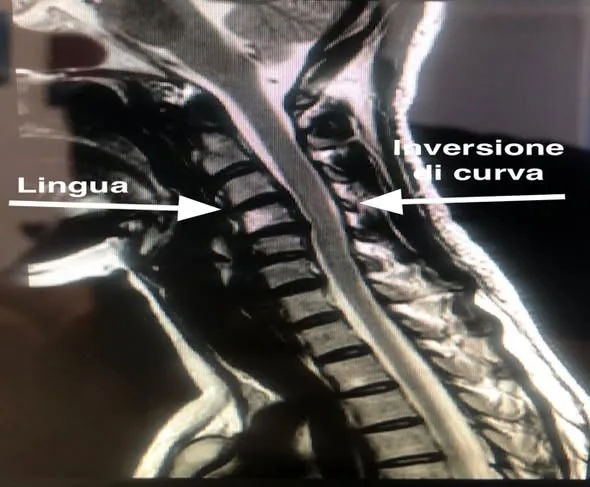
Among the factors that can contribute to this picture is an altered position of the tongue, especially when it is retruded and does not maintain proper contact with the palate. The tongue is in fact an extremely powerful organ from a biomechanical point of view and can exert considerable forces during swallowing.
In these patients it is also common to find reduced mobility of the hyoid bone, particularly in transverse movements relative to the pharynx.
The hyoid bone is the main bony support of the tongue and is considered one of the key elements of the functional balance of the cervico-cranio-mandibular region.
It has 24 muscle insertions and is connected with numerous fascial structures (Fig. 5), constituting an important center of biomechanical coordination. Thanks to its connections with the skull, mandible, tongue, cervical spine, clavicles, scapulae, pharynx and larynx, it contributes to the coordination of numerous fundamental functions.

As emphasized by Giuseppe Stefanelli, the hyoid bone can be considered a true functional “gyroscope”, able to maintain its own balance despite the continuous ascending and descending muscular tensions.
The hyoid bone in fact participates in the movements of the mandible, in swallowing, chewing, phonation and breathing, constantly responding to the postural variations of the entire body.
In the treatment of patients with dysfunctions of the stomatognathic system, the osteopathic approach aims to assess and treat the functional alterations that can involve muscles, joints and connective tissues of the cranio-cervico-mandibular region.
In my clinical experience, the application of the CM (Chewing Muscles) protocol has been a useful tool in the management of patients with oro-facial pain and dysfunctions of the masticatory muscles, always within an individual evaluation integrated with the other health professionals involved.
Each patient has specific characteristics and requires a personalized diagnostic and therapeutic pathway, which is why a correct medical diagnosis and an interdisciplinary collaboration between osteopath, dentist, orthodontist, physiatrist, physiotherapist and the other health professionals involved is essential.
The stomatognathic system is a system of extraordinary complexity, closely integrated with postural control and with numerous essential functions of the body.
An accurate evaluation of its components, together with a correct clinical assessment, can help to identify possible dysfunctions early and to plan the most appropriate therapeutic pathway.
Osteopathy, placed within a multidisciplinary approach and based on a functional evaluation of the patient, can represent a valid support in the management of musculoskeletal alterations and dysfunctions of the cranio-cervico-mandibular region, always in collaboration with the other health professionals and in compliance with medical indications.
This site uses technical cookies required for it to work and, only with your consent, third-party content (Google Maps). Read the Privacy Policy and the Cookie Policy.

